Только лучше всего это делать в период Нового Года, конец декабря и начало января. Гыкающее быдло не в счёт, главное - погода и места (а если на авто по стране, то гыкающего быдла и не увидишь).
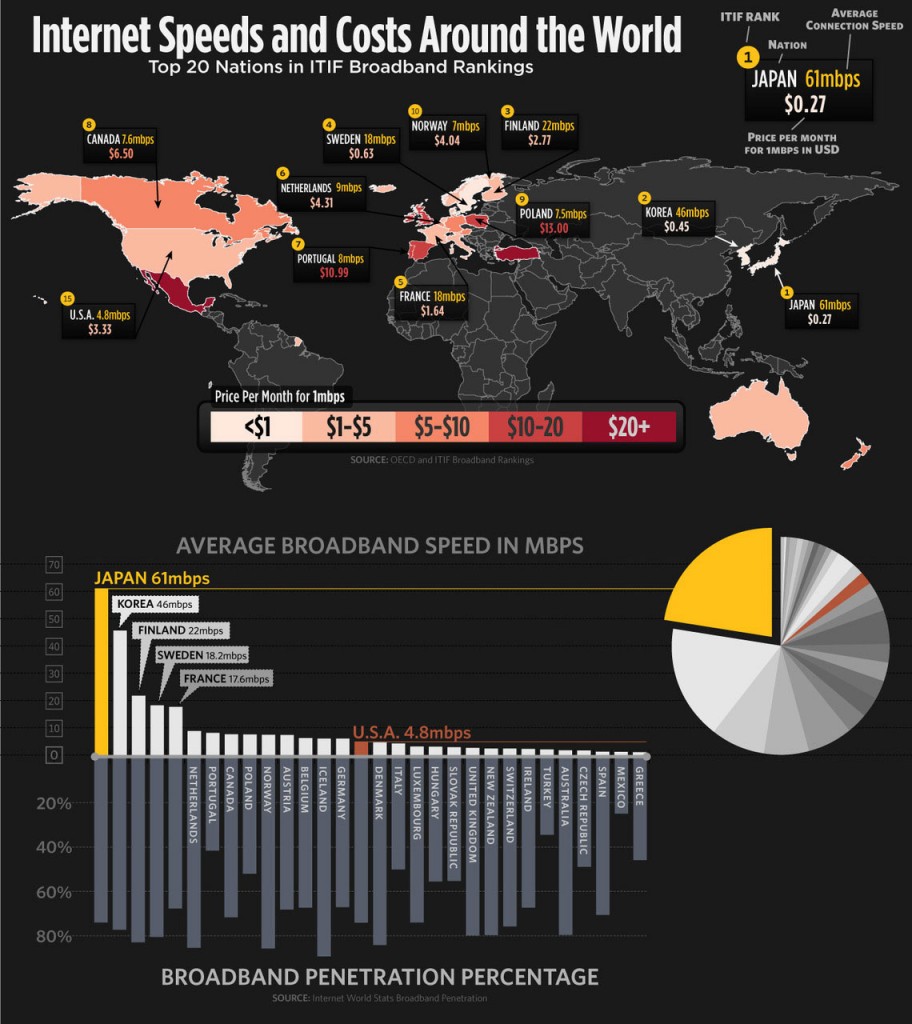
Только на форум ты не выйдешь... интернет там такой же слабый, как и в Австралии, хотя Австралия, почему-то, входит в ТОП-20 стран в мире с самым быстрым интернетом. Парадокс вот такой, по версии Сергея 555.
555 (Сергей) пишет:
...Интернет в Австралии как бы есть...
...пока только в Сиднее АDSL... около 75$ в месяц.
...Быстро внутри страны - еле-еле наружу наружу...
...я зафиксировал абсолютный рекорд скорости скачивания 3 байта в секунду...
...Приличные сервисы типа скайпа все же работают...
...Причина - монополия на рынке связи, все сводится к одной единственной компании, в руках которой подводные кабели...
Вот где кобелёк-то зарыт!
http://en.wikipedia.org/wiki/Internet_in_Australia
In March 2007, there were approximately 4.33 million broadband subscribers in Australia and 2.09 million narrowband subscribers. Between December 2007 and June 2008 there was an increase in the number of wireless internet subscribers from 433,000 to 809,000.
Customers on connection speeds on 1.5 Mbit/s have increased from 2.47 million (37% of total) in December 2007 to 3.10 million (43% of total) in June 2008. In December 2008 there were 7.996 million Internet subscribers representing a year on year increase of 13%. Currently, Australia has a theoretical 5637734.4Mbit/s of transpacific bandwidth.
History
Competition, Faster Broadband
Gradually, larger ISPs began taking over more of the delivery infrastructure themselves by taking advantage of regulated access to the unconditioned local loop. As well as significantly reducing costs, it gave the service providers complete control of their own service networks, other than the copper pair (phone line from the exchange to the customer).
The first competition to Telstra's DSLAMs was provided by then Optus subsidiary XYZed, launching business-grade xDSL services from 50 exchanges in September 2000.
Competition in the residential infrastructure market began in 2003, when Adelaide-based ISP Internode installed a DSLAM in the town of Meningie, South Australia.
Several other service providers have since begun deploying their own DSLAMs.
The presence of non-Telstra DSLAMs allowed the service providers to control the speed of connection, and most offered "uncapped" speeds, allowing the customers to connect at whatever speed their copper pair would allow, up to 8 Mbit/s. Ratification of ADSL2 and ADSL2+
increased the maximum to 12 Mbit/s, then 24 Mbit/s.
In 2005, Telstra announced it would invest A$210 million in upgrading all their ADSL exchanges to support ADSL2+ by mid 2006, though they did not say whether they would continue to restrict access speeds. However, in 2006, they announced new intentions to substantially alter their copper phone network and setup a "Fibre to the Node (FTTN)" network. This was later scrapped, with Telstra citing regulations forcing it to provide
cheap wholesale access to its competitors as the reason not to invest in upgrading their network.
In late 2006, Telstra uncapped their retail and wholesale ADSL offerings to the maximum attainable speed of ADSL to 8 Mbit/s, however with a limited 384 kbit/s upstream speed. This
has allowed many Australians access to higher speed broadband.
Wireless broadband in Australia is also thriving, with many point-to-point fixed wireless broadband providers serving broadband-poor regional and rural areas, predominantly with Motorola Canopy and WiMAX technologies. Telstra's 2006 introduction of the "Next G" HSPA network (which reportedly
covers 99% of the Australian population as of September 2008) with speeds advertised of being up to
14 Mbit/s, and stimulated investment in wireless broadband by
competitors Optus, Vodafone and Hutchison Telecommunications, who are presently expanding their HSPA networks to cover 96-98% of the Australian population.
http://comms.iselect.com.au/broadband/info/internet-providers
INTERNET PROVIDERS
TPG Internet
Virgin Mobile Internet
iPrimus Internet
iinet Internet
Dodo Internet
Exetel Internet
Optus Internet
Southern Cross Telco Internet
Telstra Internet
Internode Internet
TransACT Internet
Vodafone Internet